
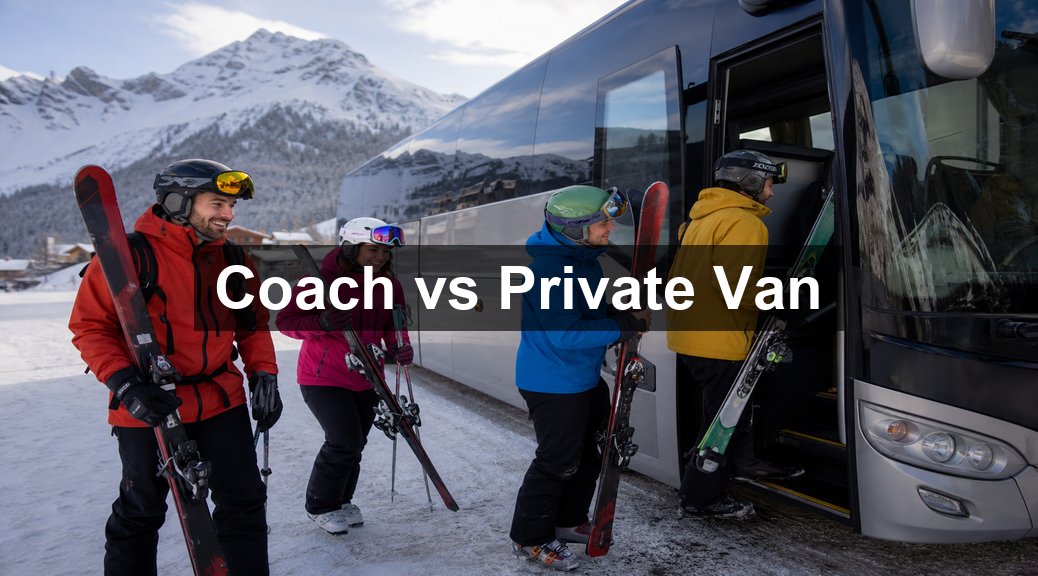
Coach Transfer vs Private Van: Which Is Right for a Group Ski Trip?
Organising a group ski trip is basically an unpaid part-time job. You spend weeks chasing friends for deposits, arguing over which resort has the best après-ski, and trying to align a dozen different flight schedules. By the time you finally get everyone into the arrivals hall at Geneva or Chambery, you are entirely out of patience. The last thing you want is a transport nightmare.
People look at their group size, see a number greater than six, and automatically assume they need a massive coach. They default to this idea because we are conditioned to think big vehicles equal cheaper travel. But mountain logistics are brutally unforgiving, and the Alps punish bad decisions quickly. Booking the wrong vehicle type means you spend the first day of your holiday freezing on a pavement, dragging luggage through the slush, and arguing with a driver who refuses to drop you at your door.
The Group Travel Reality Check
Group travel breaks down the moment you introduce winter sports gear and international borders. Moving two people through an airport is easy. Moving twelve people requires military precision. Someone always wanders off to buy a coffee, someone loses a passport, and someone else is struggling with a broken suitcase wheel.
When you add the stress of finding your onward transport into the mix, the group dynamic becomes incredibly fragile. You want a transport solution that actively absorbs the chaos, rather than adding to it. If you force an exhausted group to wait another hour for a public bus, tempers will fray before you even see a mountain.
The right transport choice depends entirely on finding the tipping point between passenger numbers and physical agility. You need a vehicle large enough to hold the skis, but small enough to actually navigate the alpine roads.
Understanding the Vehicle Options
The transport industry uses very specific terminology, and misunderstanding it often leads to terrible booking decisions. You need to know exactly what kind of machine is going to meet you at the airport.
The traditional coach transfer
When we talk about a coach transfer, we usually mean a heavy-duty, 49-seater vehicle. These are the massive machines you see lined up outside terminal buildings, idling their huge diesel engines. They are built for scale, designed to swallow entire university ski clubs or corporate away-days in a single gulp.
The physical dimensions of these vehicles dictate exactly how they operate. They are wide, incredibly long, and heavy. They belong on the fast, flat motorways that cut across the valley floors in France and Switzerland. They are completely unmatched when it comes to moving fifty people in a straight line.
But scale comes with friction. Loading fifty people takes an agonising amount of time. Someone always needs the toilet at the last minute, someone else wants to smoke, and the driver cannot depart until every single name is checked off the manifest. You end up sitting on a bus for an hour before the wheels even turn.
The modern private van
The private van sits entirely at the other end of the group travel spectrum. These are typically long-wheelbase eight-seaters, like the Opel Vivaro, or slightly larger 16-seater minibuses like the Mercedes Sprinter. They are the undisputed workhorses of the alpine transport industry.
A private van drives like a heavy car rather than an articulated lorry. This agility completely changes the journey dynamics. They slip through airport traffic easily, overtake slow-moving snowploughs on the mountain passes, and maintain a comfortable cruising speed all the way up to the snow line.
At Alps2Alps, our entire operation relies heavily on these vehicles. We specifically select vans with extended boots to handle winter equipment, and we winterise them with proper snow tyres. You get the passenger capacity of a small bus without sacrificing the speed and comfort of a premium taxi.
The shared coach vs private coach distinction
A major trap for group organisers is misunderstanding how coach tickets work. If you have a group of ten, you might try to buy ten individual seats on a scheduled, shared public coach. This means you will be sharing the vehicle with thirty strangers, stopping at multiple different resorts, and adhering to a rigid public timetable.
Hiring a private coach means you rent the entire 49-seater vehicle exclusively for your group. If you have forty people, this makes perfect financial sense. If you only have twelve people, you are paying to drag thirty-seven empty seats up a mountain.
The private van perfectly bridges this gap. It gives mid-sized groups the exclusivity and direct routing of a private hire, without forcing them to pay for a massive, oversized heavy goods vehicle.
Navigating the Airport Departure
The departure from the airport sets the tone for the entire week. If you booked seats on a shared scheduled coach, your group has to navigate the arrivals hall, locate the central bus desk, and join a massive queue. You then stand around waiting for the coach company to herd passengers from three different delayed flights into the same vehicle.
A private van completely bypasses this misery. You walk through the customs doors and immediately spot an Alps 2 Alps driver holding a tablet with your name on it. They gather your group, help with the heaviest bags, and walk you straight out to a dedicated parking zone.
You get in, the doors slide shut, and you leave the airport behind. There is no waiting for strangers, no standing in the cold, and no fighting for a window seat. The holiday essentially begins the moment you sit down in the heated cabin.
The Final Kilometre: Resort Access
The real test of any alpine transport is not how fast it drives along the flat motorway near Geneva or Lyon. The journey only gets complicated during the final thirty minutes, when the wide roads disappear, and the steep, icy inclines begin. How your vehicle handles this final kilometre entirely dictates how your travel day ends.
The turning circle problem
Mountain villages were not designed for modern traffic. Resorts like Morzine, Chamonix, and Val d’Isère grew out of tiny farming communities. Their streets are narrow, flanked by steep snowbanks, and feature aggressive hairpin bends that force drivers to slow down to a crawl.
A massive 49-seater coach simply does not fit into this geography. The turning circle of a heavy coach makes navigating a tight alpine corner physically impossible. If a coach driver misjudges a turn on a snowy road, the entire vehicle gets wedged between the snow walls, blocking the route for hours.
Because of these extreme physical limitations, local municipalities often ban large coaches from entering the resort centre altogether. They are legally restricted to the wide approach roads, forbidden from attempting the steep climbs up to the higher chalet neighbourhoods.
Getting dumped at the central depot
This municipal restriction creates a massive problem for passengers. When a coach reaches a ski resort, it stops at the designated central bus station or a massive valley car park. The driver unloads the bags, shuts the doors, and leaves you standing on the pavement.
If your accommodation is located anywhere other than directly opposite the bus station, you are immediately faced with a miserable hike. Dragging heavy luggage through a slushy, unlit town while wearing slippery winter boots is genuinely exhausting.
To avoid the walk, you end up joining the massive queue for a local resort taxi. You are then forced to pay an extortionate metered fare just to travel the final mile up the hill. It is an infuriating hidden cost that completely wipes out whatever money you saved by booking a coach in the first place.
Door-to-door van drop-offs
Private vans completely bypass this miserable end to the journey. Because a van shares the footprint of a large delivery vehicle, it can legally access the narrowest streets in the resort. They do not face the same municipal bans as the heavy coaches.
Your Alps 2 Alps driver will navigate the icy local roads, bypass the crowded central bus station entirely, and pull up directly outside your chalet reception. You get a genuine door-to-door service that actually finishes the job it started at the airport.
You simply step out of the warm cabin, lift your bags from the boot, and walk straight indoors to check in. The physical exertion is reduced to a few metres. By the time the coach passengers are still waiting for a local taxi, you are already unpacking your gear.
Luggage Logistics and Ski Gear
Winter sports gear is entirely incompatible with easy travel. None of it is designed to be carried smoothly over long distances, and all of it takes up an absurd amount of space. How much gear your group is bringing is arguably the most important factor in choosing your transfer type.
When you hire a massive coach, you get a huge underbelly hold. It sounds great in theory, but loading it is a chaotic free-for-all. Everyone chucks their bags into the dark cavern, and when you finally arrive, you have to crawl around in the dirt trying to locate your specific black suitcase among forty identical others. If you booked seats on a shared scheduled coach, the driver might actually refuse oversized bags if the hold is already full.
A private van solves this friction instantly. When you book with Alps 2 Alps, you declare your exact luggage requirements upfront. We assign a long-wheelbase minibus with a dedicated, secure cargo area that easily swallows the entire load. You do not have to fight for space, and the driver loads it systematically.
Here is what our vans are built to accommodate without sacrificing passenger legroom:
- Massive 190-centimetre double ski bags that require flat, secure loading.
- Hard-shell boot cases that bash into shins and consume valuable floor space.
- Heavy family suitcases that absolutely will not fit onto narrow public overhead racks.
- Groceries and supplies bought in the valley to avoid inflated resort prices.
Managing Delays and Flight Chaos
Aviation in the winter is inherently messy. No matter how meticulously you plan your group itinerary, the weather will occasionally intervene and ruin your schedule. De-icing procedures, European air traffic control limits, and severe snowfall routinely push arrival times back. How your transport reacts to a delay is the difference between a minor annoyance and a ruined holiday.
When aviation schedules break down
There is a specific kind of dread that hits a group organiser when the departure board flashes a two-hour delay. You suddenly have to do mental arithmetic, trying to figure out if your entire party is going to miss the onward connection.
When you finally land, the stress multiplies. A delayed flight usually means the baggage handlers are completely overwhelmed, leaving you staring at an empty luggage carousel for another forty minutes. Group members start getting hungry, exhausted, and agitated.
This chaos is unavoidable during the peak February changeover days. You have absolutely no control over the airlines or the ground staff. The only variable you can control is the flexibility of the person waiting for you outside the sliding doors.
The rigid coach schedule
If you booked a seat on a scheduled public coach, a delay is disastrous. These services run on fixed timetables. They leave when the clock dictates, completely indifferent to the fact that your plane is still circling over Lake Geneva.
Even if you hired a private 49-seater coach just for your group, you face strict legal hurdles. Coach drivers are bound by heavily regulated tachograph laws that dictate exactly how many hours they can work. If your delay pushes them over their legal driving limit, they literally cannot drive you.
You can easily find your entire group stranded in the arrivals hall at midnight. The coach company is forced to cancel the run, leaving you scrambling to find an emergency hotel room in Geneva for twenty people. It is an expensive logistical nightmare.
How private vans absorb the stress
Private vans operate with vastly more flexibility. At Alps 2 Alps, our dispatch team actively monitors live aviation data. If your plane is stuck on the tarmac in London, we already know about it long before you take off.
We adjust our driver schedules dynamically behind the scenes. If your delay is extreme, we reallocate a different van to your group to ensure a vehicle is always waiting. You never face an empty parking bay or a cancelled ride.
Because our private van drivers operate under different regulatory frameworks than heavy goods vehicles, they have the agility to wait for you. We absorb the operational stress, ensuring your group still gets to the mountain safely, regardless of how late the flight lands.
Cost Breakdown for Mid-Sized Groups
The biggest mistake group organisers make is looking at transport prices in isolation. A £30 seat on a public coach looks like an absolute bargain until you calculate the actual door-to-door cost of the journey. The hidden fees add up rapidly, completely wiping out the initial savings.
A private van is priced per vehicle, not per seat. When you book an eight-seater or a sixteen-seater van, you split the flat rate across the entire group. Suddenly, the price per head plummets. You gain all the luxury, speed, and privacy of a dedicated vehicle for practically the same price as sitting on a crowded public bus.
To give you a realistic idea of how the maths actually works, here is a breakdown of typical costs from Geneva Airport to a major French resort like Morzine.
| Group Size | Shared Scheduled Coach | Alps 2 Alps Private Van | The Hidden Hassle Factor | Solo Traveller |
|---|---|---|---|---|
| ~£40 | ~£200 | High (Wait times at airport) | Group of 4 | ~£160 |
| ~£200 (£50 per head) | Medium (Coach drops at central depot) | Group of 8 | ~£320 | ~£200 (£25 per head) |
| Zero (Door-to-door van drop-off) | Group of 15 | ~£600 | ~£400 (£26 per head) | Zero (Requires a 16-seater van) |
For a group of eight friends, taking a private van is objectively cheaper than buying eight separate tickets on a scheduled coach. You save money, chop an hour off the journey time, and get dropped exactly at your chalet door.
The Environmental and Social Impact
We cannot ignore the environmental footprint of ski holidays. Moving large numbers of people into fragile, high-altitude ecosystems creates a significant amount of carbon emissions. You want to make choices that lessen the sting on the alpine environment without ruining your holiday.
Statistically, putting forty people on a single coach is an incredibly green way to travel. If you genuinely have a group of that size, hiring one of our massive Alps 2 Alps coaches is vastly superior to ordering ten separate taxis. However, running a huge, half-empty diesel coach up a mountain for a group of twelve people is terribly inefficient.
A fully loaded private van hits the environmental sweet spot for mid-sized groups. If you have eight people occupying every seat in a modern, fuel-efficient minibus, your emissions per head drop dramatically. The transfer industry is also actively shifting; fleets are increasingly adopting highly efficient engines that minimise local air pollution in the valleys.
Then there is the social element. A private van keeps your group together in an exclusive space. You control the temperature, you play your own music over the stereo, and you can chat freely without annoying strangers. It ensures the holiday atmosphere starts the minute the airport doors slide shut, rather than forcing everyone to sit in silence on a public bus.
The Verdict: Making the Smart Choice
The argument between booking a coach and hiring a private van is really just a question of scale. If you are organising a massive university trip with fifty students, the heavy 49-seater coach is exactly what you need. We supply them regularly, and they do the heavy lifting better than anything else on the road.
But if your group falls anywhere between six and sixteen people, the private van is the undisputed champion of the Alps. It strikes the perfect balance between passenger capacity, financial efficiency, and agile resort navigation.
Booking an Alps2Alps private van means you skip the logistical friction completely. You get the speed of a car with the carrying capacity of a small bus. You arrive at the mountain relaxed, unloaded right at your door, and ready to focus entirely on the snow.
Frequently Asked Questions
Does Alps 2 Alps provide large coaches for massive groups?
Yes, we operate a vast fleet that scales from standard cars right up to heavy 49-seater coaches. If you are organising a major corporate event or a large school trip, we can provide the exact heavy-duty vehicle you require to move everyone together.
Will a private van wait for us if our flight is delayed?
Absolutely. We actively monitor live aviation data for all our private bookings. If your flight is held up by weather or air traffic control, your driver will adjust their schedule and be waiting for you in the arrivals hall when you finally land.
Do we have to share the van with other people?
No. When you book a private van transfer, you are paying for the exclusive use of that vehicle. Only the people in your specific group will be on board, ensuring total privacy and a direct route to your accommodation without any unwanted stops.
Can a private van fit all our snowboards and skis?
Yes. You declare your luggage when making the booking, and we assign a long-wheelbase minibus designed specifically to handle bulky winter sports equipment. Your double ski bags, boot cases, and heavy suitcases will all fit securely in the cargo area without crushing your legroom.


