
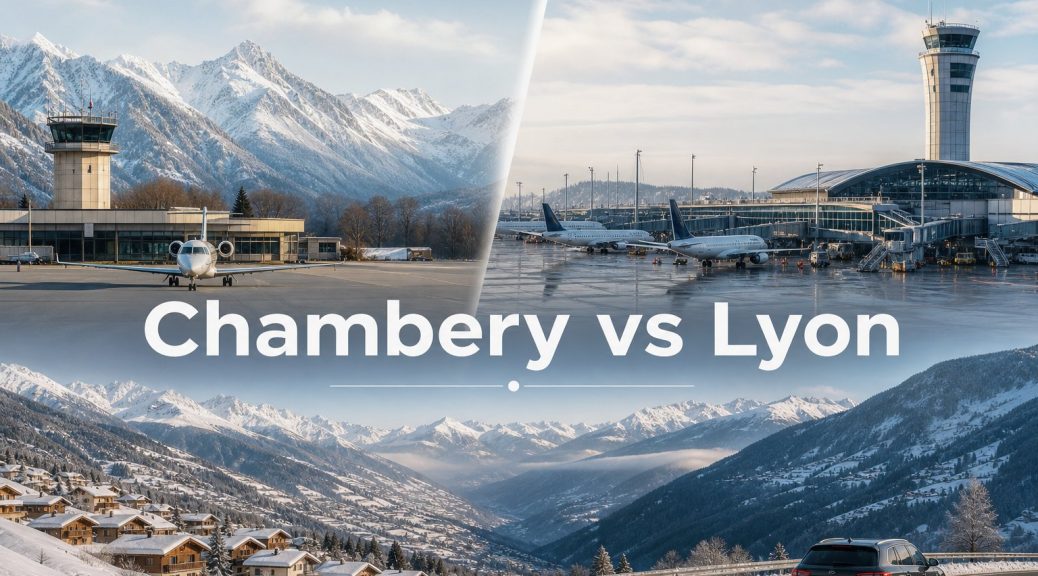
Chambery vs Lyon Airport: Which is Closer to the Tarentaise?
When planning a ski trip to the Tarentaise Valley, looking at a map provides a very clear answer about which airport is closer. Chambéry sits right on the edge of the mountains, practically touching the dual carriageway that leads directly up to Moûtiers. Lyon is situated twice as far away, out in the flatter regions to the west. If you base your entire booking decision on raw distance, the smaller regional airport wins effortlessly.
However, alpine logistics are rarely that straightforward. At Alps2Alps, we spend the entire winter driving between these airports and major resorts like Méribel, Courchevel, and Val d’Isère. The reality of getting you from the arrivals hall to the snow involves factoring in motorway tolls, weekend traffic, and the severe weather disruptions that plague mountain hubs. A short drive means absolutely nothing if your plane cannot land. Here is an honest breakdown of how these two airports perform when you actually put boots on the ground.
Flight networks and airline availability
Chambéry essentially operates as a pop-up winter airport. It wakes up in December to handle ski traffic and goes back to sleep in the spring. The flight boards are dominated by charter companies and budget airlines catering specifically to the British package holiday market. You will find plenty of routes from smaller UK regional hubs, which saves you the hassle of driving down to London.
The major drawback is the rigid timetable. The vast majority of incoming flights land on Saturdays and Sundays. If you want to fly out on a Wednesday to beat the crowds, or if you just fancy a quick long-weekend break, the schedule offers almost nothing. You have to mold your entire holiday around the weekend changeover days, which means accepting the heaviest traffic on the roads.
Lyon-Saint Exupéry is a completely different beast. It operates as a major commercial hub all year round. You get consistent daily flights from major carriers like British Airways alongside massive budget operations from EasyJet. The flexibility is brilliant. You can fly in on a Tuesday night, grab an Alps2Alps transfer, and wake up on the slopes while everyone else is still sitting in an office.
The geographical reality: Distances to the mountains
The Tarentaise Valley starts at Albertville, but the real gateway is the town of Moûtiers. Every single vehicle heading up to the biggest ski areas must pass through this point. How you reach Moûtiers depends entirely on where your plane touched down.
The drive from Chambéry
Geographically, Chambéry Airport is the undisputed champion for Tarentaise access. The drive to Moûtiers covers roughly 80 kilometres and takes about an hour and fifteen minutes when the roads are clear. You pull out of the airport, join the A430, and you are immediately heading towards the snow.
Because the distance is so short, the transfer feels like a quick hop rather than a gruelling cross-country trek. For families travelling with restless children, this is a massive advantage. You spend less time strapped into a minibus and more time actually getting settled into your chalet.
The only real issue with this route is the lack of alternatives. The dual carriageway from the airport to Albertville handles all the local commercial traffic alongside the holidaymakers. If an accident blocks the road, you are essentially stuck. There are very few back roads that can handle the volume of weekend ski traffic.
The motorway journey from Lyon
Lyon sits much further west, roughly 160 kilometres from Moûtiers. On paper, it looks like a significantly worse option. However, the drive consists almost entirely of wide, fast toll motorways. You take the A43 straight across the region before merging onto the exact same approach road used by Chambéry arrivals.
We run this route constantly. A standard transfer from Lyon to the base of the mountains takes about an hour and forty-five minutes. Yes, it takes longer than the regional alternative, but it is an incredibly smooth drive. The motorways absorb heavy weekend traffic much better than the smaller alpine roads.
You also bypass the notorious Annecy traffic jams that plague travellers coming down from Geneva. While the distance is doubled compared to Chambéry, the actual time spent in the van usually only increases by about thirty to forty minutes. It is a very reasonable trade-off for better flight options.
The Moûtiers bottleneck
Once you reach Moûtiers, the airport you flew from becomes irrelevant. The valley floor ends, and the road splits into the steep, winding passes that lead up to the mega-resorts. This is where the real traffic problems begin, regardless of where your journey started.
On a busy February Saturday, the police often set up checkpoints at the Moûtiers roundabout to enforce snow chain regulations. This turns the entire town into a massive parking lot. Hundreds of drivers pull over to wrestle with their tyres in the freezing cold, causing tailbacks that stretch for miles down the dual carriageway.
At Alps2Alps, we fit all our transfer vehicles with premium winter tyres. Our drivers know these checkpoints intimately. We usually get waved straight through by the police, saving our clients from the misery of sitting stationary at the bottom of the mountain.
Weather resilience and flight diversions
Alpine weather destroys travel plans without hesitation. The biggest difference between these two airports is how they cope when the temperature drops and the visibility vanishes. Your choice of airport dictates whether you sleep in a ski resort or a city hotel.
Chambéry’s infamous lake fog
Chambéry sits right next to Lac du Bourget, wedged tightly between steep mountain ranges. This specific geography creates a microclimate prone to thick freezing fog. When the fog rolls in, visibility drops to zero, and the airport simply shuts down. The steep approach path leaves pilots with very little margin for error.
When a plane cannot land here, it gets diverted. Most of the time, the air traffic controllers send the incoming flights to Lyon anyway. This creates absolute chaos. You land in the wrong city, wait hours for the airline to organise coaches, and then spend four hours driving back towards the mountains.
Every single transfer driver in the Alps knows about this problem. We see it happen multiple times every winter. Booking a flight to this small regional hub is always a gamble. When the sun shines, it is fantastic. When the weather turns bad, it is a logistical nightmare.
Lyon’s commercial-grade infrastructure
Lyon-Saint Exupéry does not suffer from lake fog. It sits on a wide, flat plain well away from the high alpine peaks. Because it operates as a major international hub, it is fully equipped with advanced Instrument Landing Systems (ILS) that allow planes to land safely even in terrible visibility.
The airport also possesses the heavy machinery required to deal with severe winter weather. They have massive fleets of snowploughs to keep the runways clear and advanced de-icing rigs to get outgoing planes off the ground. They simply do not close down just because it snows.
If you are travelling during a high-risk weather week in January, the commercial hub offers genuine peace of mind. Your plane will almost certainly land where it is supposed to. You might face a slightly longer drive to the resort, but you will not spend your first night sleeping on the floor of a diverted terminal.
How Alps2Alps handles the chaos
Flight diversions ruin holidays, but they do not have to ruin yours if you book with the right transfer company. Our operations team tracks every single incoming flight using live radar apps. We know your plane is diverting to Lyon long before the pilot even announces it to the cabin.
When a Chambéry flight diverts, we immediately start scrambling our fleet. If you booked a private transfer with us, we attempt to reroute a driver to pick you up from the new location. We handle the logistical headache so you do not have to fight for a seat on a crowded replacement coach.
This is exactly why we insist you provide your actual flight number when booking your transfer. If we just have your arrival time, we have no idea you are stuck on a diverted plane until you fail to walk through the arrivals gate. Radar tracking is a core part of our service.
Terminal experiences and Saturday crowds
Comparing the interiors of these two airports is like comparing a village bus stop to a major shopping centre. Chambéry is incredibly basic. You walk off the tarmac into a small building, grab your bags from a tiny belt, and walk straight out the front door. If you land on a quiet weekday, you can be in an Alps2Alps van twenty minutes after touching down. However, when multiple flights land at once on a Saturday, the small room simply cannot handle the volume of humans and ski bags.
Lyon offers a much calmer start to your holiday. The terminal is spacious, modern, and heavily reliant on natural light. You walk through efficient automated passport gates into a large baggage reclaim area. You rarely find yourself tripping over other people’s luggage. The meeting points for our drivers are clearly marked, and the whole process feels significantly less frantic.
If you face a delayed departure on the way home, the commercial hub wins effortlessly. You can find decent restaurants, comfortable seating, and duty-free shops to pass the time. Being stuck in the smaller regional terminal for four hours with restless children is an exercise in pure endurance, as the food options are minimal and seating is sparse.
Transferring to the Three Valleys
The Three Valleys area pulls in massive numbers of British skiers. Reaching these specific resorts involves navigating the roads that branch off from Moûtiers.
Reaching Courchevel and Méribel
The drive from Moûtiers up to Courchevel or Méribel takes roughly 30 to 40 minutes on a good day. The road to Méribel climbs straight up the middle of the valley and is generally wide and well-maintained. Courchevel requires a slightly more winding route, twisting through various village levels before reaching the top 1850 tier.
If you flew into Chambéry, your total transfer time to these resorts sits comfortably under two hours. It is one of the fastest airport-to-resort connections in the French Alps. You cover the distance quickly, leaving you with plenty of energy to unpack and hit the local bars.
From Lyon, you are looking at roughly two hours and twenty minutes. The extra distance on the motorway accounts for the difference. We find that clients barely notice the extra time, as the bulk of the journey takes place on high-speed roads where you can simply relax and watch the scenery.
The climb to Val Thorens
Val Thorens sits at the top of the Belleville valley. It is the highest ski resort in Europe, which naturally means it demands the longest drive. The road up from Moûtiers is a steep, continuous climb that takes nearly an hour. It is heavily exposed to the weather and frequently suffers from heavy snowdrifts.
A transfer from the regional airport to Val Thorens takes about two hours and fifteen minutes. Because the final climb is so demanding, having a shorter initial drive helps keep travel sickness at bay. Kids who struggle with winding mountain roads definitely benefit from the reduced overall transit time.
The commercial hub adds another thirty to forty minutes to the journey. You should expect to sit in the van for nearly three hours. However, because our drivers maintain a steady, professional pace, the journey remains comfortable. We do not rush the hairpin bends.
Comparing the door-to-door times
You always have to look at the total door-to-door time, not just the driving time. Chambéry gives you a shorter drive, but the baggage reclaim process can sometimes take an hour if the tiny terminal gets overwhelmed. You save time on the road but lose it waiting for your snowboard to appear.
Lyon involves a longer drive, but the terminal efficiency means you often exit the airport much faster. Your skis usually come out on the same belt as your main luggage, and our drivers are parked just outside the main doors.
Ultimately, the real-world difference between the two airports is often negligible. On a clear day, the smaller hub gets you to your chalet slightly faster. On a bad weather day, the commercial hub gets you there hours ahead of diverted flights.
Journeys to Paradiski and Espace Killy
Heading further up the Tarentaise Valley to Paradiski (Les Arcs, La Plagne) or Espace Killy (Val d’Isère, Tignes) extends the journey significantly. You have to drive past Moûtiers and continue along the valley floor to Aime or Bourg-Saint-Maurice before starting the final climbs.
Chambéry remains the geographically closer option. A transfer to Les Arcs takes about an hour and forty-five minutes. A drive all the way to Val d’Isère takes roughly two hours and fifteen minutes. It is a solid drive, but highly manageable.
The Lyon route adds the same consistent thirty to forty minutes to these journeys. A transfer to Val d’Isère will push close to three hours. When you travel this far into the mountains, the reliability of your transport matters far more than the airport you chose. The final stretch to Tignes frequently experiences avalanche control closures, and our Alps2Alps dispatch team navigates these disruptions regardless of where we picked you up.
Public transport versus private transfers
Public transport from Chambéry Airport is basically limited to scheduled coaches. There is no train station at the terminal. You have to catch a taxi into the city centre just to get on a train heading back towards the mountains. It defeats the entire purpose of flying into a local hub. The coaches work if you are on a tight budget, but you have to wait for them to fill up and endure multiple drop-offs in the valley.
Lyon actually features a stunning TGV rail station directly connected to the terminal. During the winter, you can catch direct trains straight to Moûtiers and Bourg-Saint-Maurice. It is a fantastic option, but only if your flight times align perfectly with the limited train schedule. If they do not, you are stuck waiting for hours.
Booking an Alps2Alps private transfer removes all the friction. You do not have to drag heavy ski bags across train platforms or wait in the freezing cold for a delayed bus. We take you directly from the arrivals hall to the reception desk of your hotel. It is the only way to genuinely guarantee a smooth start to your holiday.
Hidden costs and budgeting for the trip
People frequently get caught out by budget airline pricing. A cheap flight to the regional airport looks brilliant until you realise you have no cost-effective way to get up the mountain. Because fewer companies run shared transfers from the smaller hubs, you often have to pay for a private vehicle regardless of your group size.
The commercial hub sometimes has slightly more expensive flights, but the transfer market is more competitive. Always calculate the total door-to-door cost before you hit book.
| Airport Route | Average Flight Cost (per person) | Alps2Alps Transfer Type (for 4 people) | Typical Transfer Cost (per person) | Estimated Total |
|---|---|---|---|---|
| Chambéry to Moûtiers | Low (Charter/Budget) | Private Minibus | £50 – £70 | £130 – £220 |
| Lyon to Moûtiers | Moderate | Private Minibus | £60 – £80 | £160 – £260 |
| Chambéry to Val d’Isère | Low (Charter/Budget) | Private Minibus | £70 – £90 | £150 – £240 |
| Lyon to Val d’Isère | Moderate | Private Minibus | £80 – £100 | £180 – £280 |
(Note: Transfer prices fluctuate based on the exact resort, date of travel, and time of day.)
Why booking an Alps2Alps transfer matters
We know the Tarentaise Valley better than anyone else. We drive these specific motorway routes and mountain passes every single day from December through to April. When you book a vehicle with us, you are not just paying for a ride; you are paying for local expertise and peace of mind.
Our fleet is built specifically for the alpine environment. We do not use cheap rental cars, and we do not compromise on safety.
- Premium winter equipment: Every single van is fitted with high-quality winter tyres. We do not waste time stopping by the side of the road to fit snow chains while you freeze in the back.
- Live flight tracking: Our operations team monitors your plane on radar. If you are delayed by two hours, we adjust our driver schedules to ensure a van is waiting when you finally land.
- Direct routing: We take you straight to your accommodation without unnecessary stops or bus changes.
- Luggage assistance: Our drivers meet you directly in the arrivals hall and take your heavy ski bags off your hands immediately.
Frequently asked questions (FAQ)
Which airport is genuinely closer to the Tarentaise?
Chambéry is significantly closer. It sits about 80 kilometres from Moûtiers, taking roughly an hour and fifteen minutes by car. Lyon sits 160 kilometres away, taking about an hour and forty-five minutes.
Are hire cars a good idea from these airports?
Renting a car often hides massive hidden costs. Under French law, your vehicle must have winter tyres or carry snow chains. Rental desks frequently charge exorbitant daily premiums for this mandatory equipment. Furthermore, parking in resorts like Val Thorens costs a fortune. A private transfer is almost always cheaper and far less stressful.
What happens if I miss my transfer due to baggage delays?
If you booked with Alps2Alps, your driver tracks your flight and waits for you. If your skis are delayed on the oversize baggage belt, just let the driver know via the contact number provided in your booking. We factor typical baggage wait times into our schedules, so you will not be left behind just because the airport is running slowly.


