
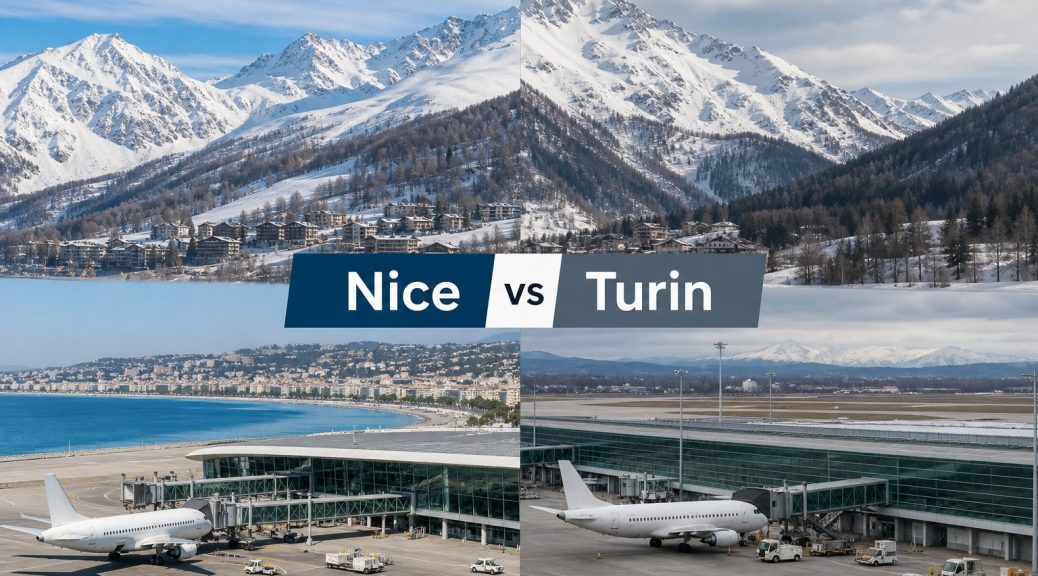
Nice vs Turin Airport: Best for the Southern Alps & Isola 2000?
Booking flights to the Southern Alps often traps skiers in a massive geographical illusion. If you look at a standard map, the Italian city of Turin and the French coastal hub of Nice appear to sit on opposite sides of the exact same mountain range. People frequently assume they can just pick whichever airport offers the cheapest budget airline seat and easily drive across the border to reach resorts like Isola 2000, Auron, or Montgenèvre.
The reality of alpine topography completely shatters that assumption. During the winter, the high-altitude passes connecting these two regions shut down completely under metres of snow. A cheap flight to the wrong side of the mountains will turn a quick ninety-minute transfer into a devastating five-hour cross-country detour. At Alps2Alps, we drive these specific southern routes every single day, regularly bailing out people who booked flights without checking the local road closures. Here is our honest, road-tested breakdown of how Nice and Turin actually compare when you factor in the winter driving reality.
Flight networks, airlines, and winter schedules
Nice Côte d’Azur is a massive international hub that operates at full tilt all year round. Because it sits on the French Riviera, it handles an enormous volume of commercial traffic. You can fly in from almost any regional UK airport on a daily basis using carriers like EasyJet, British Airways, and Air France. If you want to skip the Saturday changeover chaos and fly out on a random Wednesday afternoon, Nice gives you the schedule flexibility to actually make that happen.
Turin Caselle operates on a much smaller, highly seasonal scale. It practically sleeps through the autumn and then suddenly explodes into life to handle the winter ski charters. The flight board relies heavily on weekend budget airlines like Ryanair and Jet2, specifically targeting the British package holiday market. You can often score incredibly cheap direct flights from smaller UK hubs, saving you the misery of driving down to London.
The main drawback with the Italian airport is that rigid timetable. The flights concentrate overwhelmingly on weekends. If a severe weather event cancels your Sunday evening departure out of Turin, you might find yourself waiting days for the next direct seat. Nice simply offers a much wider and more resilient safety net for short corporate trips or non-standard chalet bookings.
The Isola 2000 trap: Why the summer map lies
Isola 2000 sits practically on the border between France and Italy. If you look at Google Maps in July, Turin looks like a highly competitive option for reaching the resort. The software shows a neat, winding road cutting straight across the mountains. We see people book Italian flights based on this exact map view every single year, and it ruins their holiday before they even unpack their skis.
The closed Col de la Lombarde
The road connecting the Italian side to Isola 2000 is called the Col de la Lombarde. It is a stunning, high-altitude mountain pass that peaks at 2,350 metres. It is highly popular with professional cyclists during the summer months.
However, the moment the first heavy snows arrive in late autumn, the local authorities drop the barriers and close the pass entirely. It does not reopen until late May or early June. There is absolutely no winter maintenance, no snowploughs, and no way through. It becomes completely impassable to all vehicle traffic.
If you fly into Turin to ski at Isola 2000 between December and April, you cannot drive over the mountain. You have to drive all the way south to the Mediterranean coast near Ventimiglia, cross the border into France, and drive back up the valley from Nice. A journey that looked like it would take two hours suddenly takes close to five. It is an absolute logistical nightmare.
The fast Tinée valley route from Nice
Nice is the only logical airport for Isola 2000. The resort essentially belongs to the French Riviera. The drive from the airport to the snow takes about an hour and thirty minutes on a clear run.
You pull out of the airport, join the RM6202 heading north out of the city, and follow the Var river before turning up the Tinée valley. It is a wide, well-maintained federal road that covers the distance at high speed. You only really slow down for the final 15 kilometres when you hit the actual alpine switchbacks leading up to the resort base.
Our Alps2Alps drivers run this specific valley route constantly. Because it starts at sea level and gradually climbs, it rarely suffers from the severe, low-level snow blockages that plague the northern alpine resorts. Unless there is a highly unusual coastal storm, you can rely on this route to get you to your chalet quickly.
Connecting to Auron and Valberg
Auron and Valberg share the exact same geographical advantages as Isola. They sit slightly further up branching valleys, but the initial drive out of Nice is exactly the same. Auron usually takes about an hour and forty-five minutes to reach.
Attempting to reach either of these villages from Italy is just as disastrous as the Isola trap. There are no secret winter tunnels cutting through the southern Mercantour national park. You are entirely boxed in by massive, impassable peaks.
A cheap Ryanair flight to Turin will instantly lose all its value when you have to pay for a massive private transfer that essentially drives you down to the Nice airport roundabout anyway. If your destination is in the Alpes-Maritimes, you must book your flights to the French coast.
Accessing Serre Chevalier and the Hautes-Alpes
If you head slightly further north into the Hautes-Alpes region, the geographical advantage flips entirely. Resorts like Serre Chevalier, Montgenèvre, and Risoul sit deep in the mountains, heavily favouring an approach from the Italian plains. This is where Turin genuinely shines and Nice becomes the terrible option.
The rapid Turin approach
Turin sits right at the base of the Susa valley. It provides incredibly fast, direct access to the mountains. From the arrivals hall, you can reach the French border resorts in just over an hour.
You jump straight onto the A32 motorway heading west. It is a wide, fast toll road that carries you deep into the Alps before you even have to think about tackling steep gradients. The Italian infrastructure here is heavily built up, largely thanks to the legacy of the 2006 Winter Olympics.
For people skiing in Montgenèvre or the northern end of the Serre Chevalier valley, Turin cuts hours off your travel day. It turns a massive mountain expedition into a quick, easy morning hop. You can realistically land at 9:00 AM and be on the chairlift by lunchtime.
Crossing the Montgenèvre pass
To reach Serre Chevalier from Turin, you have to cross the border at the Col de Montgenèvre. Unlike the passes further south, this specific route is a major international artery. It is kept open all winter long by fleets of heavy-duty snowploughs on both the French and Italian sides.
The climb up from the Italian town of Oulx is relatively short, and the pass itself sits at 1,850 metres. Because our Alps2Alps vehicles run exclusively on premium winter tyres, we maintain a steady pace up this hill while rental cars frequently pull over in panic when the snow starts falling.
Once you cross the border, you drop straight down into Briançon and the Serre Chevalier valley. It is an incredibly reliable route. The only time it genuinely struggles is during absolute whiteout blizzard conditions, at which point every road in the Alps stops moving anyway.
The long Mediterranean detour
Trying to reach Serre Chevalier from Nice is a punishing experience. You are looking at a minimum drive of four hours, and that assumes you do not hit heavy traffic leaving the coastal cities.
The route forces you up the Durance valley, winding through endless small towns and regional speed limits. It is highly scenic, but it takes forever. If you are travelling with children, spending four hours in a van just to get to the snow usually ruins the first day of the holiday.
If your travel agent suggests flying into the French Riviera to ski in the Hautes-Alpes, they are simply looking at raw flight prices and ignoring the road map. Always book Turin for this specific cluster of resorts.
Weather disruptions, fog, and flight diversions
Coastal airports handle winter differently than inland mountain hubs. Nice enjoys a Mediterranean climate. While it certainly rains, the airport rarely deals with deep snow or freezing fog. Planes land here consistently all winter long. The approach over the water is visually spectacular and rarely interrupted by low visibility.
Turin sits on the edge of the Po Valley, which suffers from a very specific winter phenomenon. Thick, freezing fog frequently rolls off the agricultural plains and settles right over the airport. When visibility drops to zero, the air traffic controllers shut the runway down completely.
When a plane cannot land in Turin, it gets diverted to Milan Malpensa or Genoa. You end up landing in the wrong city, waiting hours for the airline to organise replacement coaches, and then spending half the night driving back towards the mountains. If you travel during a notoriously foggy week in January, the coastal airport offers genuine peace of mind.
Terminal layouts and weekend baggage chaos
Your comfort level inside the airport dictates how your holiday actually begins. The difference between these two terminals is staggering, and your experience depends entirely on whether your flight departs on time or suffers a massive winter delay.
Surviving the Nice arrivals hall
Nice handles tens of millions of passengers a year. The terminal is spacious, modern, and heavily reliant on natural light. Because it services a broader mix of business travellers and general tourists alongside skiers, it lacks the frantic changeover day panic that plagues dedicated winter hubs.
You walk off the plane, pass through efficient automated passport gates, and step straight into a large, uncrowded baggage reclaim area. There is room to breathe. You rarely find yourself tripping over massive ski bags left abandoned in the walkways.
The meeting points for transfer drivers are clear. You walk out of the sliding doors, and your Alps2Alps driver is standing right there in an open concourse. You do not have to fight through three layers of shouting holiday reps just to figure out where you are supposed to go.
The manual baggage sorting in Turin
Turin is basically a large regional box. You walk off the tarmac into a small building and you are immediately at the baggage belts. On a quiet weekday, it works brilliantly. You can grab your bags and be outside in twenty minutes.
However, on a peak February Saturday, the tiny terminal collapses under the weight of winter tourism. Multiple UK charter flights land simultaneously, flooding the small arrivals room. The baggage handlers simply cannot process the sheer volume of oversized ski bags fast enough.
Ski bags are often just carried through a side door and dumped in a pile in the corner of the room. It turns into a chaotic free-for-all as passengers climb over each other to find their snowboards. It is a highly stressful environment for parents trying to keep track of their kids and their luggage at the same time.
What happens when airlines lose your gear
Airlines lose luggage constantly. Dealing with a lost bag at a massive hub like Nice is generally a straightforward administrative process. The baggage desks are staffed, they scan the tracking numbers, and they give you a reference code. They are accustomed to handling volume.
Dealing with lost baggage at a smaller Italian hub tests your patience. The single desk is often understaffed, and the queue moves at a glacial pace. If you are stuck in that queue, your transfer driver is left waiting outside in the freezing cold.
If you travel with Alps2Alps, we try to ease this pain. While we cannot magically find your lost skis, we coordinate with the airport. If the airline locates your bags the next day, we can sometimes help arrange to transport them up to the resort on one of our empty return legs, saving you from having to rent boots for the entire week.
Alps2Alps transfers versus mountain public transport
Attempting to stitch together a journey using local trains and valley buses ruins your first day in the mountains. From Nice, you can technically take a ski bus up to Isola 2000, but it runs on a very strict, limited timetable. If your EasyJet flight is delayed by an hour, you miss the bus and end up paying for a local taxi that costs an absolute fortune.
Turin offers even less public transport integration for the cross-border French resorts. You have to navigate the Italian railway system to Oulx and then try to find a connecting coach up the pass. You drag heavy bags through crowded stations, wait in the cold, and still need a local taxi for the final steep hill up to your hotel.
Booking a private transfer with Alps2Alps removes all of this friction. We take you straight from the terminal doors to your hotel reception. Our dispatch team monitors your flight live on radar. If you are delayed by two hours, we adjust our driver schedules to ensure a warm van is waiting when you finally land.
Mandatory winter equipment and the rental car trap
Renting a car in France or Italy looks incredibly cheap online until you read the local fine print. Both countries enforce strict winter driving laws between November and April. Your vehicle must carry snow chains or have winter tyres fitted. Rental desks at the airports frequently charge exorbitant daily premiums to provide this legally mandated equipment.
Furthermore, mountain parking costs a fortune. Many central hotels do not have dedicated car parks, meaning you have to pay daily rates in the municipal lots. A rental car usually just sits buried under snow for six days, costing you money every single hour.
Our transfer fleet is built specifically for the alpine environment. Every Alps2Alps vehicle is fitted with premium winter tyres as standard. We do not waste time pulling over to the side of the road to wrestle with snow chains while you freeze in the back. You get a professional driver who actually understands the traction limits of an icy switchback.
Budgeting for total door-to-door travel costs
People constantly get caught out by budget airline pricing. A ridiculously cheap flight to Turin looks like an absolute bargain until you realise you have to pay for a massive cross-country private transfer just to reach the Alpes-Maritimes. You must calculate the total door-to-door cost before you hit book.
A shorter drive means a cheaper transfer. By aligning your airport perfectly with your resort, you cut your road travel costs down significantly, easily wiping out the difference in flight ticket prices.
| Ski Resort Destination | Best Airport Option | Average Alps2Alps Transfer Time | The Crucial Route Factor |
|---|---|---|---|
| Isola 2000 | Nice | 1h 30m | Tinée valley is fast and flat |
| Auron | Nice | 1h 45m | Col de la Lombarde is closed |
| Serre Chevalier | Turin | 2h 00m | Fast motorway to Oulx |
| Montgenèvre | Turin | 1h 20m | Direct border pass access |
We answer questions about these southern routes every day. People consistently underestimate the mountain passes and overcomplicate the border crossings. Here are the blunt answers based on our daily experience driving these exact roads.
Do I need my passport to cross from Italy into France at Montgenèvre? Yes. You are crossing an international border outside of an airport. French and Italian police frequently run spot checks on the pass. You must have your passport physically accessible in the van, not buried deep inside your checked suitcase in the boot.
What happens if the road to Isola 2000 is blocked by a rockfall? It happens occasionally in the steep Tinée valley. The local French authorities are incredibly fast at clearing the RM2205 road because it is the only way up. Our operations team tracks local road closures and will adjust our departure times to ensure you still make your flight home.
Which airport is genuinely better for families with toddlers?Nice wins comfortably. The terminal is spacious, the walking distances make sense, and there are plenty of places to sit and eat if your flight is delayed. The drive up to Isola is also less winding than the mountain passes required further north, which helps significantly with travel sickness.


