
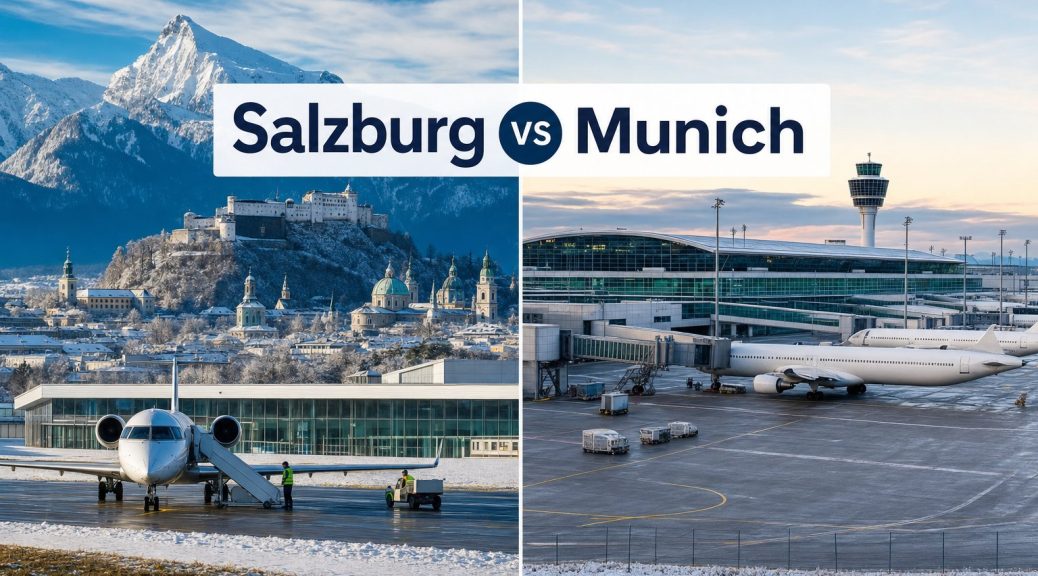
Salzburg vs Munich Airport: Which Is Better for the Austrian Alps?
Booking flights for an Austrian ski holiday usually forces a very specific logistical compromise. You either fly directly into the mountains via Salzburg, accepting a smaller choice of airlines and a highly concentrated weekend schedule, or you fly into a massive Bavarian transport hub in Munich, accepting a significantly longer drive to reach the snow. Both of these airports act as primary gateways for the eastern Austrian Alps, servicing massive ski domains like the SkiWelt, the Kitzbühel Alps, and the sprawling Salzburgerland region.
At Alps2Alps, we spend the entire winter driving our transfer vans between these two airports and the biggest resorts in Austria. We see the exact same booking mistakes happen every single year. A ridiculously cheap airline ticket to Munich looks like a massive win until you realise you just booked yourself a three-hour drive that includes a notorious international border crossing. Choosing the correct aviation hub dictates whether your holiday starts with a quick, scenic hop up the valley or a miserable slog through heavy German motorway traffic. Here is our honest, road-tested breakdown of how Salzburg and Munich actually compare.
Airline networks and winter flight schedules
Munich Airport is a global powerhouse. Lufthansa runs a massive operation here, supported by British Airways, EasyJet, and virtually every other major national carrier. If you want to fly out on a Tuesday afternoon or catch a late-night flight on a Thursday, Munich will have an option for you. If an airline cancels a flight, the sheer volume of air traffic means you can usually get bumped onto another plane leaving later that same day. This provides a massive safety net for corporate trips and short weekend breaks where you cannot afford to lose a day to travel disruptions.
Salzburg operates on a completely different scale. While it is a commercial airport, it essentially functions as a regional hub that suddenly explodes into life during the winter ski season. The flight board relies heavily on Ryanair, EasyJet, Jet2, and charter flights catering to British package holiday companies. Because the network specifically targets regional UK airports, you can often fly direct from places like Bristol, Newcastle, or Edinburgh without dragging your ski gear down to the major London terminals.
The main drawback with the Austrian hub is the rigid, weekend-heavy schedule. The flights concentrate overwhelmingly on Saturdays and Sundays. If you want to book a mid-week trip to avoid the Saturday changeover crowds, your options drop significantly. Furthermore, if a severe weather event cancels your Sunday evening flight out of Salzburg, you might find yourself waiting days for the next direct seat back to your specific UK regional airport. Munich simply offers a much wider and more resilient safety net.
Transferring to the SkiWelt and Kitzbühel Alps
The Kitzbühel Alps and the massive SkiWelt area sit right on the dividing line between these two airports. The geography here completely levels the playing field, making your choice of airport highly dependent on the exact village you booked and the time of day you plan to travel. Both routes present distinct advantages and specific bottlenecks.
Kitzbühel and Kirchberg
The legendary town of Kitzbühel, alongside its neighbouring village of Kirchberg, sits in a valley that is highly accessible from both directions. A transfer from Munich takes about an hour and forty-five minutes on a clear day. The route brings you down the A8 motorway from Bavaria, crossing the border at Kufstein, and then winding along the local valley roads.
Salzburg offers a slightly faster transfer time of roughly an hour and fifteen minutes. You drive west from the airport, cutting through the German corner near Bad Reichenhall or Lofer, before dropping down into the St Johann valley. Because the drive is shorter, it frequently feels much more manageable, especially if you are travelling with children who struggle with travel sickness.
However, the distances are close enough that the decision usually comes down to flight prices and traffic. If Munich offers a flight that saves your family hundreds of pounds, it is absolutely worth the extra thirty minutes in the van. Our Alps2Alps drivers run both of these routes constantly and will always select the most efficient local roads if the main motorways back up.
Söll and the SkiWelt region
Söll acts as a primary gateway to the massive interconnected SkiWelt area. It sits right on the northern edge of the region, incredibly close to the German border. For this specific village, and others nearby like Scheffau and Ellmau, Munich is actually a highly competitive option that frequently beats the local Austrian hub.
On a clear run, an Alps2Alps driver can get you from the Bavarian arrivals hall to Söll in just under an hour and a half. You barely cross the border before you are pulling off the main road and heading towards your hotel. The motorway infrastructure on the German side allows you to cover the distance at high speed.
Coming from Salzburg takes about the same amount of time, but the route forces you along slower, winding federal roads. You spend more time navigating single-lane traffic behind local freight lorries. If you are skiing the SkiWelt, we highly recommend checking the German flight schedules first, as it remains one of the few Austrian regions where the northern hub genuinely shines.
St Johann in Tirol
St Johann sits slightly further east than Kitzbühel, placing it firmly in Salzburg’s immediate catchment area. The transfer from the Austrian hub takes just over an hour. It is a highly scenic, straightforward drive that cuts through the mountains without requiring any severe alpine passes.
Attempting to reach St Johann from Munich pushes the journey time close to two hours. You have to navigate the entire length of the German motorway network south, cross the border, and bypass the Kitzbühel valley traffic just to reach the resort. It turns a quick regional hop into a proper cross-country journey.
For resorts on this eastern side of the Tyrolean border, Salzburg should always be your first choice. A cheap flight into Bavaria will instantly lose its value when you have to pay a massive premium for a longer private transfer. Stick to the local airport and let our drivers get you to the snow faster.
Journeys into the Salzburgerland resorts
When you book a holiday in the Salzburgerland region, the geographical map firmly dictates your travel plans. This massive winter sports area sits directly south of Salzburg airport. Choosing to fly into Munich for these resorts introduces massive, unnecessary logistical hurdles.
Zell am See and Kaprun
Zell am See and Kaprun share a spectacular ski area set around a lake and a massive glacier. From Salzburg airport, the drive takes roughly an hour and twenty minutes. The route follows the wide, fast Pinzgau valley floor, meaning you avoid the terrifying, steep switchbacks that plague other alpine regions.
Munich is entirely the wrong choice for this destination. A transfer from the German hub takes well over two and a half hours. You have to drive all the way into Austria, navigate the heavily congested roads around the Chiemsee lake, and then push deep into the southern mountains. It is an exhausting way to start a holiday.
Our Alps2Alps fleet handles the Salzburg to Zell am See route multiple times a day. Because the road remains relatively flat until you reach the Kaprun glacier base, it is an incredibly smooth ride. You can genuinely land in Austria at midday and be out on the slopes before the lifts close.
Saalbach-Hinterglemm
The Skicircus Saalbach-Hinterglemm Leogang Fieberbrunn is one of the largest ski areas in the world. Accessing the main villages of Saalbach and Hinterglemm from Salzburg takes about an hour and thirty minutes. The route sweeps down past Zell am See before cutting into the Glemmtal valley.
Because Saalbach sits at the end of a dead-end valley, the final stretch of the drive can suffer from heavy traffic on Saturday afternoons. Thousands of skiers all try to funnel up the same road simultaneously. By flying into the closer Austrian airport, you hit this valley bottleneck much earlier than the crowds arriving from Germany.
A Munich transfer to Saalbach pushes close to three hours. If you add Saturday border traffic to that estimate, you could easily spend four hours sitting in a van. We strongly advise our clients to completely ignore the German flight schedules if they plan on staying anywhere near the Skicircus.
Obertauern and its altitude
Obertauern is famous for its snow reliability, largely because the village sits at a lofty 1,740 metres. It is one of the highest resort bases in the region. The drive from Salzburg takes about an hour and fifteen minutes, relying heavily on the A10 Tauern motorway before a steep final climb up the mountain pass.
That final pass is aggressive and heavily exposed to winter storms. Because our Alps2Alps vans run exclusively on premium winter tyres, we maintain a steady pace up the mountain while rental cars pull over to wrestle with snow chains.
Coming from Munich to Obertauern takes nearly three hours. The mental toll of a long motorway drive followed by a steep, demanding alpine climb usually leaves passengers feeling completely drained. Keeping the initial road transfer short by flying into Salzburg makes the final ascent much more bearable.
The reality of the German-Austrian border crossing
If you fly into Munich, you have to cross the border into Austria. Prior to 2015, this was essentially an invisible line on a map. Today, the Kiefersfelden/Kufstein border crossing on the A93 motorway is a notorious traffic bottleneck. The German federal police frequently run spot checks on vehicles entering the country, which causes massive tailbacks.
On a Saturday morning in February, this specific stretch of motorway turns into a slow-moving parking lot. You edge forward a few metres, stop, and repeat. I have watched standard two-hour transfers inflate by an additional hour simply because the road infrastructure cannot handle the sheer volume of skiers trying to leave Bavaria.
Flying into Salzburg completely eliminates this specific problem. You land inside Austria. You bypass the international border checks, the massive toll queues, and the worst of the Bavarian holiday traffic. For resorts located deep in the Austrian mountains, skipping the German border crossing is arguably the most valuable advantage the local airport possesses.
Navigating the terminal experience on a Saturday
Your comfort level inside the airport dictates how your holiday actually begins. The difference between these two terminals is staggering, and your experience depends entirely on whether your flight departs on time or suffers a massive winter delay.
Surviving the Munich megahub
Munich handles tens of millions of passengers a year. The terminal is enormous, featuring multiple floors, excellent restaurants, and even a dedicated Bavarian brewery. If you have three hours to kill during a flight delay, you can easily find a quiet corner, grab a proper meal, and connect to fast, reliable Wi-Fi. The sheer size of the place absorbs the Saturday crowds incredibly well.
The downside to this scale is the walking distance. Getting from your arrival gate to the baggage hall often involves a very long trek. When you are dragging children and hand luggage after an early morning flight, the sheer footprint of the airport feels exhausting.
Finding your transfer driver is generally straightforward. Once you clear the massive baggage hall, you walk through the sliding doors into a wide, spacious arrivals concourse. Your Alps2Alps driver will be waiting there, and because the terminal is so large, you do not have to fight through a mob of holiday reps to find them.
The compact nature of Salzburg
Salzburg is essentially a large regional box. You walk off the tarmac, step into a small building, and you are immediately at the baggage belts. On a quiet Tuesday, it is an absolute dream. You can easily clear passport control, grab your bags, and be sitting in an Alps2Alps van twenty minutes after touching down.
However, on a peak February Saturday, the tiny terminal collapses under the weight of winter tourism. Multiple UK charter flights land simultaneously, flooding the small arrivals room with thousands of stressed people. The baggage belts groan under the weight, and the crowds make it difficult to even see where your suitcase is located.
If your flight gets severely delayed on the way home, Salzburg tests your patience. The food options are minimal, the seating is sparse, and the departure lounge feels claustrophobic. Kids handle the space poorly when trapped there for hours. It works brilliantly when flights are on time, but it offers zero comfort during a delay.
Handling oversize ski luggage
Ski bags ruin the flow of any baggage reclaim area. Munich uses a fully automated, commercial-grade baggage system. Your main suitcase arrives on the standard carousel, and you walk over to a dedicated oversize belt to collect your skis. It occasionally backs up, but the staff are highly accustomed to handling massive volumes of winter sports gear.
In Salzburg, baggage handling feels much more manual. Tractors pull the luggage carts up to a side door, and staff physically pass the ski bags through. When the tiny room fills up, people end up piling their canvas board bags in the corners, creating a chaotic free-for-all as passengers climb over each other to find their equipment.
Our Alps2Alps drivers know exactly how stressful this process is. They wait patiently just outside the doors. The moment you emerge from the chaos, we take those heavy ski bags off your hands immediately. You do not have to drag them across an icy car park or try to force them onto a crowded public bus.
Alpine weather resilience and flight diversions
Winter weather destroys travel plans without hesitation. The biggest difference between these two airports is how they cope when the temperature drops, the snow falls, and the visibility vanishes. Your choice of airport heavily influences your risk of being diverted.
Munich sits on a wide, flat plain well north of the Alps. Because it operates as a major international hub, it is equipped with advanced Instrument Landing Systems (ILS) that allow planes to land safely even in terrible visibility. They also possess massive fleets of snowploughs and heavy-duty de-icing rigs. When a blizzard hits the region, Munich keeps running long after the smaller alpine hubs have shut down entirely.
Salzburg sits much closer to the mountains. While it does not suffer from the extreme valley winds that plague Innsbruck, it is still susceptible to heavy freezing fog and intense local snow squalls. If a massive storm forces the airport to close, air traffic control usually diverts incoming flights straight to Munich anyway. By booking flights directly to the German hub during a notoriously stormy week, you buy yourself genuine peace of mind.
The Alps2Alps transfer advantage
Attempting to stitch together a journey using the Austrian rail network and local valley buses ruins your first day in the mountains. You drag heavy bags through crowded stations, wait in the freezing cold, and still need a local taxi for the final steep hill up to your hotel. Renting a car brings its own set of miseries, including mandatory winter tyre fees and exorbitant resort parking charges.
Booking a private transfer with Alps2Alps completely removes the friction from your travel day. We handle the alpine logistics so you can actually enjoy the journey.
- Premium Winter Fleet: Every single van is fitted with high-quality winter tyres as standard. We do not waste time stopping by the side of the road to fit snow chains while you freeze in the back.
- Direct Hotel Routing: We take you straight from the terminal doors to your hotel reception. There are no unnecessary stops, bus changes, or dragging luggage through the snow.
- Live Flight Tracking: Our dispatch team monitors your plane on radar. If your EasyJet flight is delayed by two hours, we adjust our driver schedules to ensure a warm van is waiting when you finally land.
- Transparent Pricing: We quote you a price for the vehicle, and that is what you pay. There are no hidden fees for bringing a snowboard bag or sitting in heavy border traffic.
Total holiday budgeting and hidden costs
People constantly get caught out by budget airline pricing. A ridiculously cheap Ryanair flight to Munich looks like an absolute bargain until you realise you have to pay for a massive cross-country private transfer just to reach Salzburgerland. You must calculate the total door-to-door cost before you hit book.
The table below outlines typical costs for a group of four travelling to Kitzbühel in mid-February, assuming they book a few months in advance.
| Airport Route | Average Flight Cost (per person) | Alps2Alps Transfer Type (for 4 people) | Typical Transfer Cost (per person) | Estimated Total Journey Cost |
|---|---|---|---|---|
| Salzburg to Kitzbühel | Moderate to High | Private Minibus | £45 – £65 | £195 – £285 |
| Munich to Kitzbühel | Low to Moderate | Private Minibus | £65 – £85 | £165 – £245 |
| Salzburg to Saalbach | Moderate to High | Private Minibus | £50 – £70 | £200 – £290 |
| Munich to Saalbach | Low | Private Minibus | £90 – £120 | £170 – £250 |
(Note: Transfer prices fluctuate based on the exact resort location, booking date, and the time of day your flight lands. Always request a live quote on our website.)
Frequently asked questions (FAQ)
Every week, we receive emails from skiers trying to hack their travel logistics. People constantly overthink the train schedules or worry about border rules. Here are the blunt answers based on our daily experience on the ground.
Do I need a passport to cross from Munich into Austria?
Yes. You are crossing an international border. Even though both countries operate within the Schengen zone, the German federal police frequently run spot checks on the motorway, particularly near the Kufstein border crossing. Your driver handles the vehicle, but you must have your passport physically accessible in the van, not buried inside your checked suitcase.
What happens if my Salzburg flight is diverted to Munich?
If you booked your transfer with Alps2Alps, our operations team already knows. We track your flight live on radar. If we see your plane turn towards Bavaria due to fog, we immediately start scrambling our fleet to reroute a driver to pick you up from the new location. You handle the airline delays; we handle making sure a van is waiting for you at the other end.
Which airport is better for families with young children?
If you are skiing in the Salzburgerland region, Salzburg wins comfortably because the drive time to the resorts is significantly shorter. A child will handle a slightly crowded terminal much better than they will handle an extra two hours strapped into a van driving across Bavaria. Keeping the road transfer time to an absolute minimum is the secret to a stress-free family holiday.


One thought on “Salzburg vs Munich Airport: Which Is Better for the Austrian Alps?”
Comments are closed.