
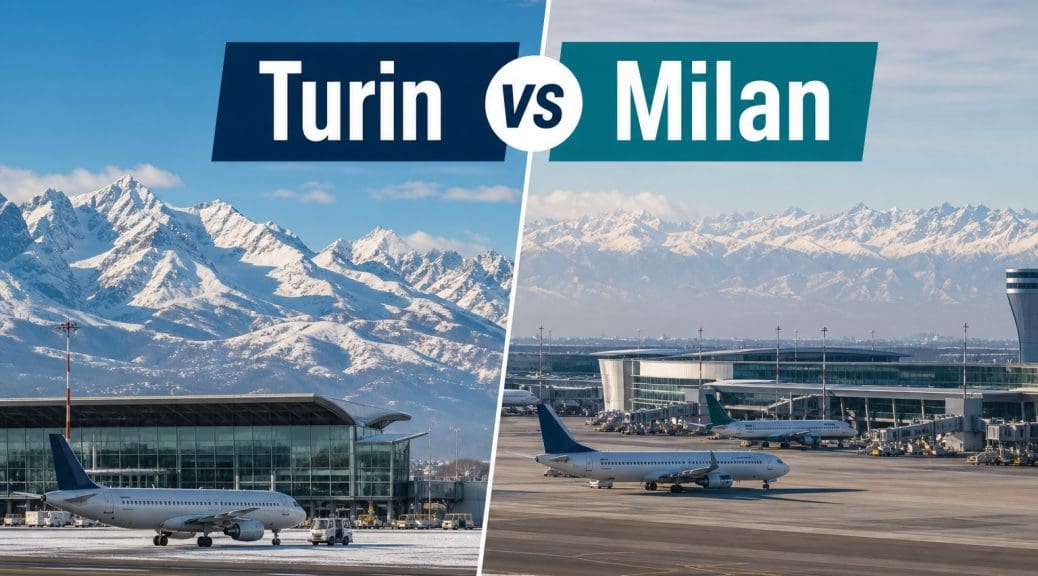
Turin vs Milan Airport: Best for Italian Alps Ski Resorts?
Booking flights for an Italian ski holiday usually forces a sharp geographical compromise. You either fly directly into the foothills of the mountains via Turin, accepting a smaller choice of airlines, or you fly into the sprawling industrial plains surrounding Milan to take advantage of massive budget airline schedules. Turin physically touches the Alps, acting as the immediate gateway to the Aosta Valley and the Milky Way. Milan sits much further east, requiring a solid hour of motorway driving just to reach the base of the mountains.
At Alps2Alps, our drivers spend the entire winter running these specific routes across northern Italy. We watch people make the exact same booking mistakes every single year. A cheap Ryanair flight into Milan looks like an absolute bargain until you realise you just booked yourself a four-hour transfer to Sestriere, entirely wiping out your first evening on the snow. Choosing the correct aviation hub dictates whether your holiday starts with a quick hop up the valley or a miserable slog through Lombardy traffic. Here is our road-tested breakdown of how Turin and Milan actually compare.
Airline networks and budget flight options
When people talk about flying into Milan for a ski trip, they usually mean Milan Malpensa. It is the international heavyweight of the region. EasyJet uses Terminal 2 as a massive base, flying in from almost every regional UK airport. You also get heavily subsidised routes from British Airways and other national carriers. If you want to fly out on a random Tuesday morning, or if you simply miss a scheduled flight, Malpensa offers the sheer volume of air traffic required to get you on another plane the same day.
Turin Caselle operates on a completely different scale. It essentially functions as a regional airport that suddenly explodes into life from December to April. The flight board relies heavily on weekend charter flights catering to British package holiday companies, alongside a steady stream of Ryanair and EasyJet arrivals. Because the network specifically targets regional UK departures, you can often fly direct from places like Bristol or Edinburgh without dragging your ski gear down to London.
The main drawback with the Turin hub is its rigid, weekend-heavy schedule. The flights concentrate overwhelmingly on Saturdays and Sundays. If you want to book a mid-week corporate trip to avoid the Saturday changeover crowds, your options drop significantly. Furthermore, if a severe weather event cancels your Sunday evening flight out of Turin, you might find yourself waiting several days for the next direct seat back to the UK. Milan simply offers a much wider safety net.
Journey times to the Aosta Valley
The Aosta Valley is a deep, spectacular trench cutting straight into the highest peaks in Europe. It is serviced by the A5 motorway, which runs up from the plains directly to the Mont Blanc tunnel. Both airports use this exact same road, but their starting positions differ wildly.
Courmayeur and the Mont Blanc tunnel
Turin is the undisputed champion for reaching Courmayeur. The drive takes roughly an hour and thirty minutes on a clear day. You pull out of the Caselle airport, skirt around the northern edge of the city, and immediately join the A5 motorway heading north. You barely have time to get comfortable in the transfer van before you see the massive granite walls of Mont Blanc dominating the skyline.
Milan Malpensa sits much further east. A standard transfer from the Lombardy hub takes around two hours and fifteen minutes, easily stretching past two and a half hours on a busy Saturday. You have to navigate the busy A4 motorway across to Santhià before you even join the valley road. We run this route constantly, and while the motorways are fast, the extra distance wears you down after an early morning flight.
The real wildcard here is the Mont Blanc tunnel traffic. On peak holiday weekends, day-trippers and heavy freight lorries clog the road leading up to the tunnel entrance just past Courmayeur. Our Alps2Alps drivers know exactly where these queues form. Because we use live traffic tracking, we frequently exit the motorway early to bypass the stationary toll traffic, getting you to your chalet while other vans sit burning fuel.
Cervinia and the shadow of the Matterhorn
Cervinia sits high up a side valley, sharing its ski area with Zermatt in Switzerland. Geographically, Turin is closer. You can usually reach the resort in about an hour and forty-five minutes. The drive takes you up the main Aosta artery before you turn off at Châtillon and start the steep climb up the Valtournenche valley.
Milan Malpensa is surprisingly competitive for this specific resort. Because Malpensa is located well north of Milan city centre, the drive across to the Aosta valley is relatively direct. A transfer takes roughly two hours. It is one of the few Aosta Valley resorts where flying into the larger commercial hub does not punish you with an excessively long drive.
The final climb up to Cervinia is demanding regardless of where you landed. The village sits at 2,050 metres, meaning the approach road is heavily exposed to winter storms. We do not waste time pulling over to fit snow chains because every single Alps2Alps vehicle runs on premium winter tyres. We maintain a steady pace up those winding switchbacks so you do not arrive feeling violently travel-sick.
Pila and the central valley base
Pila is a unique resort because you do not actually drive up a mountain to reach it. Most visitors stay in the city of Aosta on the valley floor and take the massive 18-minute gondola straight up to the slopes. From Turin airport, getting to the Aosta gondola base takes just an hour and fifteen minutes. It is a brilliant, highly efficient travel day.
Coming from Milan to Aosta city pushes the journey over two hours. The mental toll of a longer motorway drive just to reach a valley floor city rarely makes sense if you have the option of flying into the Piedmont region instead. The extra hour spent in the van entirely wipes out the money you saved booking a cheaper flight to Malpensa.
If you actually booked accommodation up in the Pila resort itself rather than the city, add another 30 minutes of aggressive, winding mountain driving to your journey. The road up from Aosta is steep and tight. Having a shorter initial motorway run from Turin makes this final climb much more bearable, especially for families with restless toddlers.
Accessing the Milky Way (Via Lattea) ski area
West of Turin lies the sprawling Via Lattea ski area, connecting several Italian villages with Montgenèvre across the French border. This is Turin’s absolute home turf. If you are skiing in this region, flying into Milan is a logistical mistake that will cost you hours of your holiday.
Sestriere and high-altitude reliability
Sestriere was purpose-built for winter sports and sits at a lofty 2,035 metres. From Turin Caselle, the transfer is a highly efficient hour and thirty minutes. The route takes you straight down the Susa valley on the A32 motorway before a final, wide, sweeping climb up from Oulx. It is one of our most frequent routes, and it rarely suffers from severe traffic blockages.
Attempting to reach Sestriere from Milan is a brutal haul. You are looking at a minimum three-hour drive, and that assumes the traffic around Milan itself is clear. You have to cross the entire width of northern Italy, bypass the sprawling Turin ring road, and then start the mountain ascent. It is an exhausting way to start a holiday.
The final road up to Sestriere is generally well-maintained, largely due to the infrastructure left over from the 2006 Winter Olympics. Our Alps2Alps drivers know the braking points on these wide switchbacks intimately. If you stick to the local airport, the journey feels like a quick sprint rather than a cross-country endurance test.
Sauze d’Oulx and the weekend traffic
Sauze d’Oulx pulls in massive numbers of British skiers looking for lively après-ski and extensive tree-lined runs. Because it sits slightly lower down the mountain than Sestriere, the drive from Turin is even shorter. You can easily reach the village in about an hour and fifteen minutes.
Because Sauze is so popular with the domestic Italian market, the Friday night and Saturday morning traffic out of Turin gets heavily congested. The locals flock to the Susa valley for the weekend. We monitor the A32 motorway constantly. If the main toll booths back up, our drivers often drop onto the older state roads to keep the van moving.
Flying into Milan for a Sauze d’Oulx trip is entirely counterproductive. It turns a quick hour-long hop into a two-and-a-half-hour cross-country trek. The streets in Sauze are notoriously narrow and steep, frequently blocking large coach transfers. Booking a private Alps2Alps minibus ensures we can navigate those tight village lanes and drop you directly at your hotel door.
Montgenèvre across the French border
Montgenèvre is a French resort, but because of the local alpine geography, it is accessed almost exclusively via Italy. Turin is the only logical airport choice here. The transfer takes roughly an hour and twenty minutes, driving past Oulx and climbing up through the border town of Clavière.
The border crossing itself is generally frictionless. There are no massive toll booths or physical barriers slowing the traffic down like there are at the Mont Blanc tunnel. You essentially drive up a hill, pass a sign, and you are in France. Our drivers handle this specific route multiple times a day during peak season.
If your travel agent suggests flying into Milan for a Montgenèvre trip, tell them to look at a topographical map. A transfer from Lombardy would take well over three hours and cost an absolute fortune. Keep it simple, fly into the Piedmont region, and let us handle the quick drive up the pass.
Travelling to the central and eastern Dolomites
If you cross over to the eastern half of the Italian Alps, the map flips completely. The Lombardy and Trentino regions are dominated by massive, sprawling resorts that sit incredibly far from Turin. When heading to the central Alps or the Dolomites, Milan Malpensa, alongside Bergamo, becomes the primary gateway.
Livigno and the toll tunnel tax
Livigno is famous for its duty-free shopping and highly reliable snow record, but it is notoriously difficult to reach. Milan Malpensa is the standard entry point, but you should expect a solid four-hour drive. The route forces you all the way up Lake Como, deep into the Valtellina valley, and finally through the Munt La Schera toll tunnel.
The Munt La Schera tunnel is a single-lane, alternating traffic bottleneck. On Saturdays, the tunnel authorities enforce strict one-way windows. If you miss your time slot, you sit in a freezing queue for hours. Our Alps2Alps dispatch team times our Milan departures meticulously to ensure our vans hit the tunnel during the correct directional window.
Do not even think about flying into Turin for a Livigno ski trip. The transfer would take five to six hours minimum. You would spend an entire day of your holiday just sitting on a motorway staring at the back of Italian freight lorries. The eastern resorts demand eastern airports.
Bormio and the Valtellina valley
Bormio sits in the same massive Valtellina valley as Livigno but does not require passing through the dreaded tunnel. From Milan Malpensa, the transfer takes about three hours. It is a long, grinding drive up the eastern side of Lake Como, which frequently suffers from heavy local commuter traffic.
While Milan is the best major hub for Bormio, Bergamo (Milan Orio al Serio) is often slightly better if you can find flights, shaving about thirty minutes off the journey. Regardless of which Milan airport you use, the final hour of the drive is a slow crawl up the valley floor behind heavy local traffic.
Turin is completely useless for Bormio. The geography simply does not work. You would have to drive across the entire industrial heartland of northern Italy just to reach the start of the valley. A cheap flight to the west will instantly lose all its value when you have to pay a massive premium for a cross-country private transfer.
Madonna di Campiglio and the Brenta group
Madonna di Campiglio sits in the spectacular Brenta Dolomites. Technically, Verona or Bergamo are the absolute best airports for this resort, but Milan Malpensa is frequently used by British skiers due to the superior flight schedules. From Malpensa, expect a transfer time of around three and a half hours.
The route takes you past Brescia and up past Lake Garda before winding into the mountains. The roads get incredibly tight and steep once you pass Pinzolo. Because our drivers know the specific width restrictions of these Trentino roads, we never deploy vehicles that will get stuck on the tighter switchbacks.
Once again, Turin should not even be part of the conversation for this resort. If you book accommodation anywhere near the Dolomites, you must fly into the Milan airports, Verona, or Venice. Mixing western airports with eastern resorts ruins your first day entirely.
Navigating Italian motorway toll booths (The Autostrada)
The Italian Autostrada network is fast, well-maintained, and incredibly expensive. It operates entirely on a toll system. You take a ticket when you join, and you pay when you exit. On a quiet Tuesday, it is highly efficient. On a busy February Saturday, the major toll plazas turn into a chaotic free-for-all.
When you fly into Milan and drive towards the Aosta Valley, you have to pass through multiple major toll barriers near Santhià. The queues here can stretch for kilometres. Local drivers frequently cut across five lanes of traffic to reach the electronic ‘Telepass’ lanes, creating a highly stressful environment for anyone unfamiliar with Italian driving culture.
Because our Alps2Alps vans are equipped with electronic toll tags, we do not stop to dig for loose change or argue with credit card machines. We use the dedicated fast lanes, bypassing the massive queues of rental cars and keeping your journey completely fluid.
| Ski Resort Destination | Best Airport Option | Average Alps2Alps Transfer Time | The Crucial Bottleneck |
|---|---|---|---|
| Courmayeur | Turin | 1h 30m | Mont Blanc Tunnel traffic |
| Sestriere | Turin | 1h 30m | Susa Valley Friday rush |
| Cervinia | Turin | 1h 45m | Valtournenche switchbacks |
| Bormio | Milan (Malpensa/Bergamo) | 3h 00m | Lake Como coastal road |
| Livigno | Milan (Malpensa/Bergamo) | 4h 00m | Munt La Schera tunnel timing |
Your comfort level inside the airport dictates how your holiday actually begins. Milan Malpensa handles tens of millions of passengers a year. The terminal is massive, featuring multiple concourses, endless duty-free shops, and decent restaurants. If a severe blizzard delays your flight by four hours, Malpensa offers plenty of space to find a quiet corner and a hot meal.
Turin is basically a large regional box. You walk off the tarmac, into a small building, and grab your bags. On a quiet weekday, it is brilliant. You can be sitting in an Alps2Alps van twenty minutes after touching down. However, when multiple UK charter flights land simultaneously on a Saturday, the tiny terminal collapses under the sheer volume of humans.
Handling oversized winter luggage tests the patience of any skier, and Italian baggage handlers are notoriously indifferent. In Turin, the small baggage room fills with stressed people climbing over each other to find their snowboards. At Malpensa, the oversize belts frequently jam due to the massive volume of gear. We always advise our clients to remain patient; your skis will eventually appear, and our drivers will be waiting right outside the doors when they do.
Dealing with alpine weather and fog delays
Northern Italy suffers from a very specific meteorological problem during the winter: thick, freezing fog. The moisture coming off the Po River and the surrounding agricultural plains frequently blankets the region in a dense mist that reduces visibility to absolute zero. Your choice of airport heavily influences how you deal with this.
Milan Malpensa sits right in the fog zone. However, because it operates as a major international hub, it is equipped with commercial-grade Instrument Landing Systems (ILS). Planes can generally land there even when the fog is thick. They also possess the heavy machinery required to de-ice dozens of aircraft simultaneously.
Turin sits slightly higher, tucked closer to the mountains. It escapes the worst of the Po Valley fog, but it occasionally suffers from heavy crosswinds sweeping down the alpine valleys. If a severe storm forces an airport closure, flights bound for Turin are usually diverted to Milan anyway. Because the Alps2Alps dispatch team tracks live radar data, we know about these diversions immediately and start rerouting our fleet to pick you up from the new location before you even step off the plane.
Why an Alps2Alps transfer beats a rental car
Renting a car in Italy looks incredibly cheap online until you read the local fine print. The queues at the Malpensa rental desks on a Saturday are legendary, often taking two hours just to hand over the keys. Attempting to stitch together a journey using Italian rental cars usually ruins your first day in the mountains.
When you book a private transfer with Alps2Alps, we strip away all the friction from your travel day. You step off the plane, hand over your heavy ski bags, and we handle the aggressive Italian motorway traffic.
- Mandatory winter equipment: Under Italian law, your vehicle must carry snow chains or have winter tyres fitted between November and April. Rental desks frequently charge exorbitant daily premiums for this. Every Alps2Alps van runs on premium winter tyres as standard.
- Direct hotel routing: We take you straight from the terminal doors to your hotel reception. You do not have to drag bags through snowy car parks or try to decipher Italian parking signs.
- Live flight tracking: Our operations team monitors your plane. If your Ryanair flight is delayed by two hours, we adjust our driver schedules to ensure a warm van is waiting when you finally land.
- Zero hidden costs: We quote you a price for the vehicle, and that is what you pay. There are no surprise fees for bringing a snowboard or sitting in heavy Autostrada traffic.
Frequently asked questions (FAQ)
Every week, we receive emails from skiers trying to hack their travel logistics across northern Italy. People constantly overthink the train schedules or underestimate the mountain roads. Here are the blunt answers based on our experience driving these routes daily.
Are there direct trains from these airports to the ski resorts?
No. Italian alpine resorts do not generally have train stations in the villages. The closest you can get to the Aosta valley by train involves multiple changes from Turin city centre, and you still end up at a local station miles from your hotel. Taking a train with heavy ski luggage is a genuinely miserable experience.
What happens if I miss my transfer due to baggage delays?
If you booked with Alps2Alps, your driver tracks your flight and waits for you. If your skis are delayed on the oversize baggage belt at Milan Malpensa, just let the driver know via the contact number provided. We factor typical Italian baggage wait times into our schedules, so you will not be abandoned just because the airport is running slowly.
Which airport is better for families with young children?
If you are skiing in the western Alps, Turin wins comfortably because the drive time to the resorts is so much shorter. A child will handle a slightly crowded terminal much better than they will handle an extra two hours strapped into a van driving across Lombardy. Minimising the road transfer time is the secret to a stress-free family holiday.


One thought on “Turin vs Milan Airport: Best for Italian Alps Ski Resorts?”
Comments are closed.